
For more than twelve hours, the sound of office work stopped. Starting around 16:00 GMT on Thursday, November 12, people in dozens of countries found that Outlook would not open, Teams meetings would not connect and Copilot would not answer. The disruption ran into Friday the 13th, a coincidence that was not lost on the internet. This article sets out what is confirmed, what experts and ordinary users are saying about the cause, and why a separate story, the sudden exit of NVIDIA's Jensen Huang, keeps getting tangled up with it.
What happened
According to Al Jazeera, problems began at about 16:00 GMT on Thursday, and within about an hour the tracker Downdetector had logged reports from 74 countries and territories. The Guardian reported nearly 130,000 users globally reporting trouble reaching Word, Excel, PowerPoint, Outlook and Teams, as well as SharePoint and OneDrive. Microsoft says more than 430 million people use its 365 apps, so the true number affected is unknown and almost certainly far higher than the reports.
Reuters described it as an outage of more than 12 hours that crippled communications for businesses and governments, forcing some organizations back to fax machines and halting at least one bond repurchase in Europe. Microsoft said the outage hit features tied to Exchange Online, its cloud email and scheduling hub, while applications not connected to it kept working. Organizations running Microsoft software on their own servers were somewhat spared.
Who felt it
The list of affected organizations shows how deeply the software is woven into daily life. Government systems in Singapore and Japan were disrupted, as were communications at the Supreme Court of the Philippines. In Australia the national spy agency and federal police were among those hit. In the United Kingdom the NHS and the Metropolitan Police were affected, with the Met saying its ability to take some online crime reports was reduced, though its response to calls was not.
In business, Euronext told companies to phone in trades, Aviva activated backups for its earnings calls, and Maersk warned customers of delayed updates. Indian airlines IndiGo, Akasa Air and Air India reported problems with email support, while saying flight operations were unaffected. OpenAI and Anthropic both reported trouble with Microsoft connectors, a reminder that AI tools now depend on the same plumbing.
What Microsoft says caused it
Microsoft has not published a final root cause, but its running updates have narrowed the picture.
First, it described "elevated load" on part of its infrastructure. It then said the load was not driven by a spike in traffic but by a large number of servers being "unexpectedly unavailable," which pushed work onto the machines still running. The servers had failed automated health checks. Microsoft said it validated an alternative health check method on a subset of servers, which let them return to service, and began restarting and validating others while preparing an automated process to find and restart unresponsive servers.
Second, Microsoft said a review of recent changes had identified configuration updates as a potential cause, and that it was assessing whether reverting them would speed recovery. It paused all deployments and configuration changes as a precaution. Al Jazeera reported that on Friday the company was rolling back a network change but did not say whether that change was to blame. Later, Microsoft reported "encouraging recovery progress," although some restored servers had failed again overnight and it described only "marginal success" at one stage.
The scenarios being discussed
Scenario 1: A bad configuration change
This is the leading explanation, and it comes from Microsoft's own statements. Australia's Home Affairs Minister Tony Burke said Microsoft had told him it believed it was dealing with something similar to the 2024 CrowdStrike incident, where an update went awry, rather than a cyberattack. CrowdStrike blamed a bug in an update that pushed bad data to millions of computers in July 2024.
Scenario 2: A cascading failure
Mark Gregory, an associate professor at RMIT University, told the Guardian the outage appeared to affect the network layer and might resemble the configuration fault that took down Optus in 2023. His reasoning: when part of a pool of servers is lost, all users crowd onto the rest, overloading them, and "you end up with a cascading problem." He said the lesson is better testing of configuration changes before they reach the live network, and that businesses should keep backup options.
Scenario 3: A cyberattack
Many people's first fear, and Microsoft has repeatedly rejected it. Charles Lamanna, Microsoft's executive vice president for Copilot, Agents and Platform, said there was "no indication this is the result of malicious or cyber activity." The Australian government said Microsoft told it the same. Absent evidence, this should be treated as a rumor, though investigators usually keep the question open until a full report is published.
Scenario 4: A pattern of fragility
Analysts point out this is not an isolated event. Reuters notes Microsoft had 365 outages in January this year and October last year, and an Azure outage last month. Josh Gilbert of eToro said the bigger worry is that this is not the first 365 outage this year, and that recurring problems give IT departments a reason to think twice about relying on one provider. Others noted that high switching costs may keep customers in place anyway. Microsoft shares dipped only 0.4% in early trading.
Scenario 5: Society's single point of failure
Walter Pasquarelli of the University of Cambridge called it "first and foremost a communication risk," and Control Risks' Caitlin Egen called it a "wake-up call" even for firms with contingency plans. Technology analyst Rupert Goodwins said the scale was impressive but the event not unprecedented. On the financial side, Morningstar DBRS estimated global insured losses between $300 million and $500 million, below the 2024 CrowdStrike toll.
What users are saying
The mood online was mixed. Companies like Air India and Burger King joked about the downtime, the World Health Organization suggested a walk, and some employees reported an office that felt like the 1990s, with colleagues chatting, ordering breakfast and planning a pub visit. Others were less amused: traders confirming deals by fax, people holding meetings on WhatsApp, and firms delaying earnings calls. A common refrain was that many people keep a Gmail account as a fallback in case Microsoft goes down.
The Jensen Huang and Bill Gates storyline
Here the facts need careful separation from rumor, because the outage landed on the same day as another major tech headline.
What is confirmed about Huang
On Thursday, November 12, NVIDIA announced that Jensen Huang had resigned as president, CEO and board member, effective immediately. Chief financial officer Colette Kress became interim CEO. The resignation followed days of scrutiny after The New York Times reported that Huang had an affair with a businesswoman U.S. intelligence suspects of being a Chinese spy, which Beijing denies, and later reports of a relationship with a senior NVIDIA executive who reported to him. Huang had apologized to employees for being "unfaithful to my wife." NVIDIA said it had "no reason to believe" national security or company secrets were compromised, and Al Jazeera's reporter noted there is no established evidence he knowingly helped Beijing. NVIDIA's shares have fallen more than 30% since an October high.
The Gates disagreement
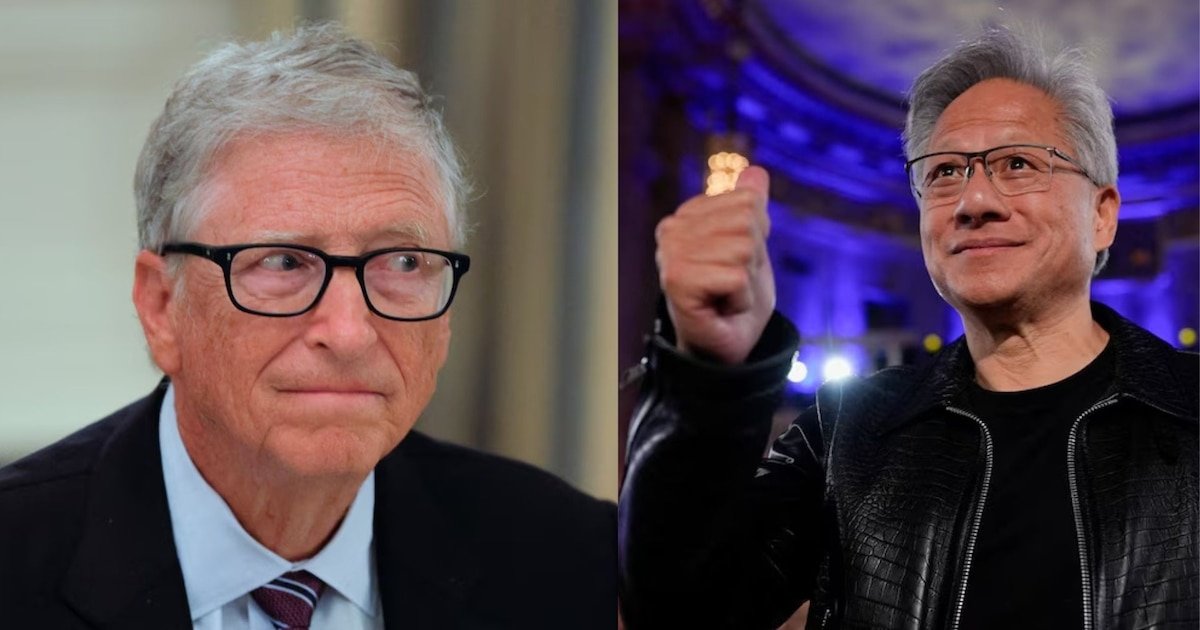
The only documented friction between Huang and Bill Gates is a policy disagreement from late August. Gates published an essay on August 26 proposing a tax on robots and AI tokens, arguing the tax code nudges employers toward replacing people with machines. The next day on Fox Business, Huang said: "I love the heck out of Bill … but I don't see what he sees." He argued AI will be a net job creator. That is a public difference of opinion between two men who are, by Huang's own words, on friendly terms. It is not a reported feud, and it has no connection to Microsoft's servers. Gates is also described as Microsoft's co-founder, not an executive running its cloud operations.
Is there any link to the outage?
No credible source connects the two events. Microsoft's explanations involve server health checks and configuration changes, not any individual. The overlap in timing, both stories breaking on November 12, is the likely reason the theory spread. The Guardian even ran a link to its Huang story beside its outage report, which may have encouraged readers to connect them. Without evidence, claims that a personal grudge or a rivalry among powerful executives caused or influenced the outage should be treated as speculation.
What happens next
Microsoft says its teams are reviewing what happened and how to prevent similar issues. Expect a post-incident report that will say whether the configuration change was the trigger and why servers kept failing health checks. Regulators and large customers, especially in government and finance, are likely to ask harder questions about concentration risk. For individuals and small businesses, the practical lessons are modest but real: keep a backup email address, know how to reach colleagues outside Teams, and save important files locally.
Sources
*Reuters, "Hours-long Microsoft outage disrupts businesses, governments globally," November 13, 2026.
*The Guardian, "Global Microsoft outage affects Outlook and Teams users, with company 'restarting' servers," November 2026.
*Al Jazeera, "Microsoft hit by global outages: What happened and why?" November 13, 2026, and its live coverage. *AP News, "A global Microsoft outage offers a multitude of possibilities," November 13, 2026.
*CBS News, "Microsoft battling major worldwide outage," November 13, 2026.
*AP News and Al Jazeera coverage of Jensen Huang's resignation, November 12, 2026.
*NVIDIA press release, "NVIDIA Announces CEO Transition," November 12, 2026.
* Fortune via Yahoo Finance and Times of India coverage of the Huang and Gates tax disagreement, August 2026.
This article reflects reporting available as of the afternoon of November 13, 2026. Microsoft had not published a final root cause at the time of writing