
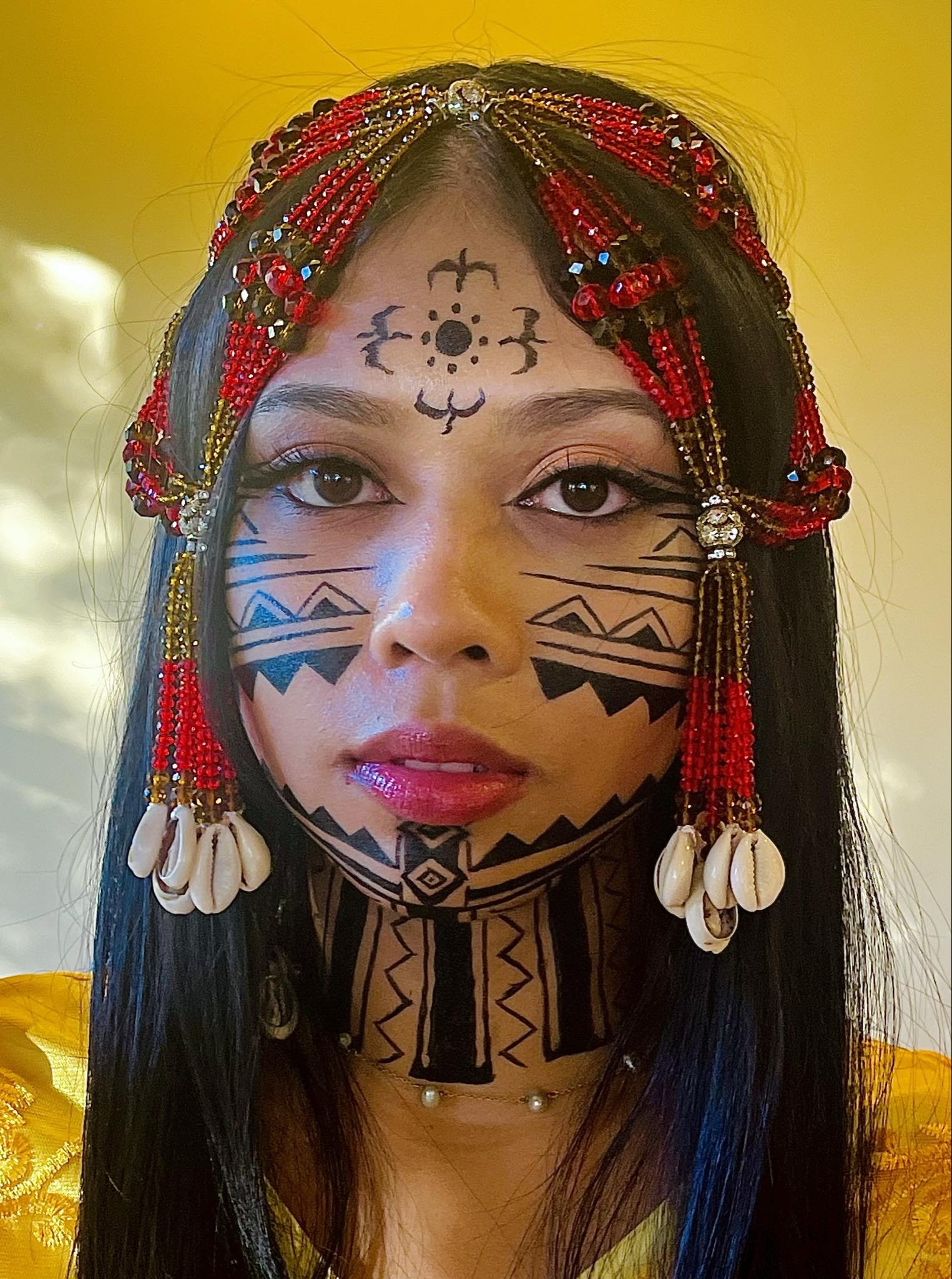
When Spanish explorers reached the central Philippines in the 1500s, they saw people whose bodies were covered in tattoos. They called them Los Pintados, "the Painted Ones," and named the region Islas de los Pintados. The name has outlasted the era, and it points to something worth knowing: the islands had a rich, organized and well-connected civilization centuries before colonization.
Tattoos as a Language of Honor
For the early Visayans and many other groups, tattooing was not decoration. It was a record of who you were. Spanish chroniclers described men whose chests, arms, legs and backs were covered in patterns, and noted that the markings had to be earned. Warriors received tattoos for bravery in battle, and the designs showed rank, achievement and community identity. Women were also tattooed, usually on the hands and arms, with patterns of beauty and belonging.
The practice is still alive. In Buscalan, Kalinga, the master tattooist Whang-od Oggay (Maria Oggay) has kept the tradition going. She hand-taps designs with a thorn and a bamboo stick, and she has trained a new generation, including her grandnieces. Her work shows that tattooing here is a living art, not a museum piece.
Society: Barangays, Leaders and Ranks
The basic unit of society was the barangay, a community led by a datu (or rajah in some regions). The word comes from balangay, the plank-built boats that carried early settlers across the sea. Archaeologists found remarkable examples in Butuan, Agusan del Norte.
Society was generally organized in layers:
Datu and nobility: leaders, judges and war chiefs
Maharlika and timawa: warriors and free commoners who owed their leader service but were not enslaved
Alipin: dependents and those bound by debt, whose status was often more flexible than later European ideas of slavery
Women held real standing. They could inherit property, lead rituals and take part in trade, and many communities had no strong custom of male-only authority.
Spirit, Ritual and the Babaylan
Early Filipinos honored a world filled with spirits. They prayed to anito, the spirits of ancestors and nature, and recognized powerful deities such as Bathala in Tagalog regions and Mayari, the moon goddess. Spiritual leaders called babaylan in the Visayas (and by other names elsewhere) served as healers, mediators and keepers of community knowledge. Many were women or people who crossed gender roles, and they were respected as the link between the human and spirit worlds.
Burial customs show deep belief in an afterlife. The Manunggul Jar from Palawan's Tabon Caves, about 2,800 years old, shows two figures in a boat sailing the dead to the next world.
Writing, Art and Craft
Before Latin letters, many Filipinos used Baybayin, a script from the Brahmic family. Its oldest dated example is the Laguna Copperplate Inscription (900 CE), a legal document recording the cancellation of a debt. It shows that writing, law and record-keeping were already in use.
Craft traditions included weaving, pottery, metalwork and gold smithing. Fine gold ornaments, like the Golden Tara found in Agusan, show wealth and skill. Oral traditions such as epics, riddles and chants carried history from one generation to the next. Examples include the Hudhud of the Ifugao and the Biag ni Lam-ang of the Ilocanos.
Farmers, Sailors and Traders
The Philippines was never isolated. Islanders were skilled sailors who traded with China, Southeast Asian kingdoms and beyond. They exchanged gold, beeswax, pearls and forest goods for porcelain, silk, beads and iron. Porcelain found at burial sites across the islands shows how far these links reached.
In the north, communities carved the Cordillera rice terraces into mountain sides, a feat of engineering and water management that many people still farm. Elsewhere, people grew rice, root crops and coconut, fished, hunted and gathered. Meals often centered on rice and fish, with cooking styles that live on today in dishes boiled, grilled and cooked in vinegar.
Customs of Daily Life
Dress was suited to the tropics: woven cloth, bark cloth and abaca fibers, often with ornaments of gold, shell, and beads. Some groups practiced body modification such as filed teeth or gold-pegged teeth. Festivals marked harvests, births, weddings and victories. Feasts, music, dance and bamboo instruments like the kudyapi (a two-stringed lute) filled community life.
Why the Painted Ones Matter Today
Colonial writers often described pre-colonial Filipinos through a narrow lens. A closer look at the archaeology, the chronicles and living traditions shows a people with sophisticated governance, art, spirituality and trade. Much survives: in the Cordillera, in indigenous communities, in language, in food and in the bayanihan spirit of working together.
Remembering the Painted Ones is not nostalgia. It is a way of recognizing that Filipino identity has deep roots, and that those roots are still growing.